
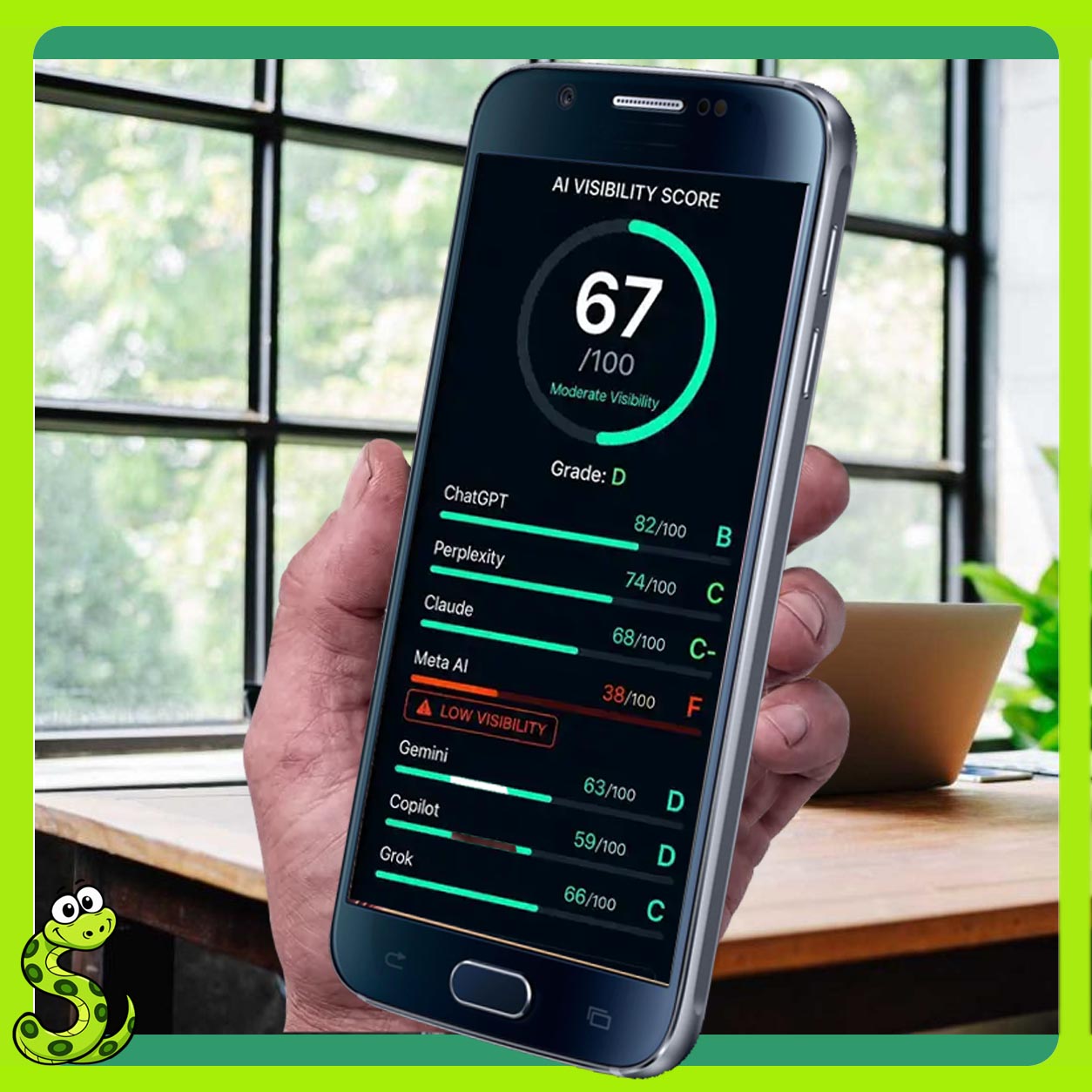
Congratulations! Your Website Has a 95% SEO Score.
Excellent news.
Your website is apparently doing brilliantly.
The SEO audit tool has given you a lovely green badge, your technical health is looking fantastic, and somebody has probably suggested you should be delighted.
There's just one small problem.
Nobody can find your website on Google.
Not for the products you sell. Not for the services you offer. Not even when you search for the obvious phrases your customers would use.
So what's going on?
Has Google failed to appreciate your magnificent 95% score?
Not quite.
The problem is that your SEO score and your Google rankings are measuring two very different things.
What Does an SEO Score Actually Measure?
Most website SEO scores are calculated by automated tools that examine technical aspects of your website.
They might check whether:
Your pages have title tags and meta descriptions.
Your headings are structured correctly.
Your images have alternative text.
Your website works on mobile devices.
Your pages can be crawled.
Your internal links work.
Your website has obvious technical errors.
All perfectly reasonable things to check.
And fixing problems in these areas can make a genuine difference.
But here's the catch.
Passing a technical SEO audit doesn't mean your website deserves to rank above your competitors.
It means you've passed the checks that particular tool was designed to perform.
That's it.
The Difference Between a Healthy Website and a Visible Website
Think of it like opening a shop.
You've painted the walls, polished the windows, installed beautiful lighting and made sure the doors open properly.
Everything is immaculate.
You give yourself a 95% shop-readiness score.
Fantastic.
Unfortunately, you've opened the shop in a back alley nobody knows exists.
Your shop might be technically perfect.
But that doesn't mean customers are walking through the door.
Your website works much the same way.
Technical SEO helps ensure Google can access and understand your content.
But search visibility also depends on relevance, competition, content quality, authority signals and how well your pages satisfy what people are searching for.
A healthy website is a good starting point.
It isn't a guarantee of visibility.
Six SEO Scores That Don't Tell the Whole Story
Let's look at some of the numbers that regularly appear in SEO reports.
| SEO Metric | What It Actually Measures | What It Doesn't Prove |
|---|---|---|
| Website SEO Score | Automated technical and on-page checks | That customers can find your website |
| Domain Authority (DA) | Moz's proprietary prediction of ranking potential, heavily influenced by link data | That Google assigns your website an official authority score |
| Domain Rating (DR) | Ahrefs' measurement of backlink profile strength | That you rank for your important keywords |
| Site Health Score | Technical audit results, often based on passed checks and issue severity | That your SEO campaign is successful |
| PageSpeed / Performance Score | Technical loading and performance measurements | That your website ranks well |
| SEO Visibility Score | Estimated visibility based on tracked keywords, rankings and search-volume models | Your exact position in every real-world search |
Notice something?
Every one of these measurements can be useful.
But none is a universal measure of SEO success.
And several are proprietary measurements created by companies selling SEO tools.
Google does not use Moz Domain Authority or Ahrefs Domain Rating as its own ranking scores.
That doesn't make those metrics worthless.
It simply means you need to understand what they represent.
A 95% Score Can Hide Some Pretty Big Problems
Imagine two competing websites.
Website A
Technical SEO Score: 97%
Excellent page speed
Clean headings and metadata
Very little relevant content
Few meaningful backlinks
Barely visible for important searches
Website B
Technical SEO Score: 78%
A handful of technical issues
Detailed, useful content
Relevant links from other websites
Strong visibility for valuable searches
Which website is doing better?
From a technical audit perspective, Website A.
From a search visibility perspective, quite possibly Website B.
Of course, Website B should still fix its technical problems.
But improving its score from 78% to 95% isn't automatically more valuable than improving content, fixing an indexing issue or targeting a relevant search term.
The priority should be the problems that actually matter, not simply the ones that move a score.
What Should You Measure Instead?
If you're paying somebody to improve your SEO, or doing it yourself, start with a few practical questions.
1. Does Google Know Your Pages Exist?
First, check whether Google has indexed the pages you want people to find.
Google Search Console can help identify indexing issues.
If an important page isn't indexed, it generally can't appear in ordinary Google search results.
But remember: being indexed doesn't guarantee a ranking for any particular keyword.
2. Which Keywords Are You Actually Ranking For?
This is where things become more interesting.
If you're a plumber in Phoenix, you probably care about searches such as "emergency plumber Phoenix" or "water heater repair Phoenix."
If you run a clothing boutique in Sedona, phrases such as "women's clothing store Sedona" might be important.
You need to know whether your website appears for those searches and where.
Not just whether your homepage has a correctly formatted title tag.
3. Are Your Rankings Improving?
A single ranking check gives you a snapshot.
Checking again over time helps reveal changes.
Are you moving up for important phrases?
Are competitors overtaking you?
Did a newly published page begin appearing for relevant searches?
Rankings fluctuate, so don't panic over every small movement.
Look for meaningful patterns.
4. Are People Actually Clicking?
Google Search Console provides data about impressions, clicks, click-through rates and average positions.
This is particularly valuable because it reflects your website's actual Google Search performance rather than only a third-party estimate.
A page might appear thousands of times but receive very few clicks.
That could indicate an opportunity to improve its title, content relevance or search appearance.
It could also reflect the type of search or the features Google displays above ordinary results.
5. Are Those Visitors Becoming Customers?
This is the ultimate business question.
Are visitors contacting you, making purchases, booking appointments or taking other valuable actions?
Rankings and clicks are important indicators, but they're not the same as revenue.
You may need website analytics, conversion tracking or business records to connect SEO activity to actual outcomes.
No single SEO score can do that for you.
Why Do SEO Tools Love Scores So Much?
Because scores are easy to understand.
A green 95 looks good.
A red 42 looks bad.
And moving a score from 42 to 95 gives you a satisfying sense of progress.
There's nothing inherently wrong with simplifying complex information.
The problem starts when that simplified number is presented as proof of something it doesn't measure.
A technical audit score can tell you whether you've addressed technical issues.
It cannot, by itself, tell you whether more potential customers are discovering your business.
And that's a distinction every website owner deserves to understand.
No More BS Scores
This is one of the reasons we built SEO Snake.
We believe business owners should be able to investigate their own search visibility without having to decipher a collection of mysterious percentages.
Want to know where your website appears for an important keyword?
Check it.
Want to see which competitors are showing up?
Investigate them.
Want to understand what Google Search Console is telling you?
Look at the actual search data.
Want to examine technical issues or backlinks?
Do that too.
Different tools answer different questions.
There's no need to pretend they can all be combined into one magical number that defines your website's success.
So Should You Ignore Your SEO Score?
Absolutely not.
Technical SEO matters.
If your website has broken pages, serious indexing problems, incorrect redirects or other technical issues, those problems deserve attention.
A good audit can help identify them.
But don't confuse fixing technical problems with achieving business results.
Use SEO scores as diagnostic tools.
Use search visibility, relevant organic traffic and meaningful conversions to evaluate progress.
And remember that SEO improvements take time. No report can guarantee rankings, traffic or sales.
The Bottom Line
If your website has a 95% SEO score, congratulations.
It may well be in excellent technical shape.
But before you celebrate, ask one more question.
Can the people searching for what you sell actually find you?
Because that's a much more interesting number to investigate.
SEO Snake — No BS Scores. Just Results.
Run the reports you need, when you need them. No monthly subscription required.
Related reading: Your SEO Agency Might Not Like This